
Statement Lighting
Chandeliers
Sculptural ceiling lights for dining rooms, stairwells and entrance halls. Tiered glass, brass arms and modern reinterpretations of a timeless form.
Filters
2 items
Sort Most relevant
-
Signature Signature Small runs, real materials, made to order. The top of the Enso range.

CHANDELIERS
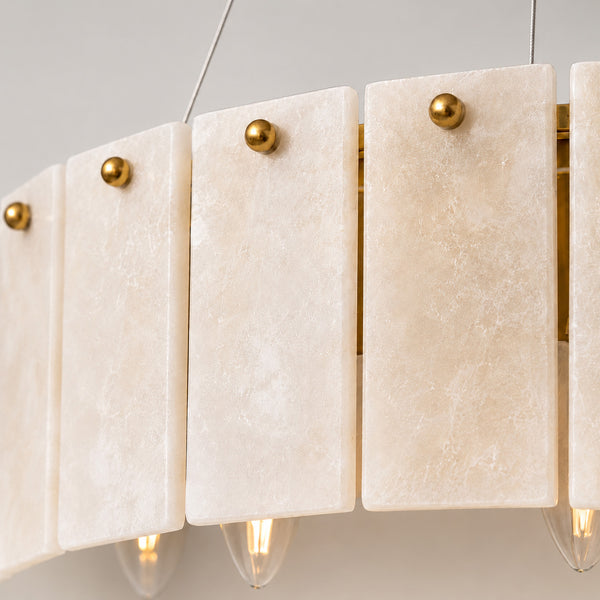
Solara Alabaster Ring Chandelier — Antique Brass
Made in United Kingdom
Antique BrassE14 SES12 lampholders£920In stockView product → -
Signature Signature Small runs, real materials, made to order. The top of the Enso range.

CHANDELIERS
Solara Alabaster Ring Chandelier — Satin Brass
Made in United Kingdom
BrassE14 SES12 lampholders£920In stockView product →


Buying Guide
Frequently Asked Questions
What height should I hang a chandelier above a dining table?
Hang your chandelier 75-90cm above the dining table surface to ensure adequate headroom whilst maintaining visual impact. For ceilings higher than 2.4m, add approximately 7.5cm of hanging length for every additional 30cm of ceiling height. The bottom of the chandelier should never hang lower than 150cm from the floor to prevent head collisions.
Do I need an electrician to install a chandelier in the UK?
Under Part P of the Building Regulations, you can replace an existing light fitting on a like-for-like basis without certification, provided the circuit is unaltered. However, chandeliers often exceed 5kg and require additional ceiling support beyond a standard BESA box, which constitutes structural work requiring a qualified electrician or certification. Always verify your ceiling can support the weight and that your existing wiring is suitable for the chandelier's total wattage.
How do I choose the right size chandelier for my room?
Add your room's length and width in metres, then multiply by 10 to get the ideal chandelier diameter in centimetres (e.g., 5m + 4m = 9, × 10 = 90cm diameter). For dining tables specifically, the chandelier should be 30-45cm narrower than the table width to maintain proper proportions. In rooms with ceilings above 2.4m, you can increase the size by 10-15% to fill the vertical space appropriately.
Can I use LED bulbs in a chandelier?
Yes, LED bulbs work in chandeliers provided you match the cap type (typically E14 small Edison screw for candle bulbs) and check the maximum wattage rating per socket. Many traditional chandeliers are designed for 40W incandescent bulbs, but you can use LED equivalents of 4-6W that produce similar light output. Ensure LED bulbs are dimmable if your chandelier is on a dimmer switch, as non-dimmable LEDs will flicker or fail.
Will a chandelier work with smart bulbs and dimmer switches?
Smart bulbs (such as Philips Hue or LIFX) are compatible with chandeliers using standard E14 or E27 fittings, though costs multiply quickly across multiple bulbs. If using smart bulbs, remove any existing dimmer switch as these conflict with the bulb's internal electronics, causing buzzing or reduced lifespan. Alternatively, fit a standard smart dimmer module behind the switch, which works with dimmable LED bulbs and is typically more cost-effective for multi-bulb chandeliers.
What's the difference between a chandelier rated for sloped versus flat ceilings?
Standard chandeliers are designed for flat ceilings with vertical mounting hardware, whilst sloped ceiling chandeliers include adjustable canopies or swivel joints that accommodate angles up to 45 degrees. If you have a vaulted or cathedral ceiling, you must use a fixture specifically rated for sloped installation, as standard mounting can stress the electrical connections and create safety hazards. Some manufacturers offer adaptors, but these must be purchased from the original supplier to maintain warranty and safety compliance.
How many bulbs should my chandelier have for adequate lighting?
For dining rooms, aim for 150-200 lumens per square metre, so a 15m² dining room needs approximately 2,250-3,000 lumens total. With modern LED candle bulbs producing 400-470 lumens each, a 5-6 arm chandelier typically provides sufficient light, though this depends on whether it's your sole light source. For ambient-only lighting or rooms with additional spotlights, you can reduce this by 30-40%.